Featured Essays

T. from This Will Hold stands with Texas Rep. Jasmine Crockett

She Won: Georgia Used a Fake County Vote Bank In the 2024 Election

And Why We Can’t Allow Legislators and the Media to Continue Ignoring This

Jun 14, 2026

Data Changed After Tabulation

To briefly recap our 2024 election findings, last fall we identified five fake county vote banks hidden inside counties that do not exist. You can circle back to read that article here:

How Did 6 Million People Vote In Burke County, Florida—When It Doesn’t Exist?

This Will Hold

·

November 24, 2025

How Did 6 Million People Vote In Burke County, Florida—When It Doesn't Exist?

Read full story

In Florida, we proved the use of a fake county vote bank labeled “Burke County” that was deployed to ensure Amendment 4, the women’s-rights ballot initiative, failed by the exact 60%/40% margin required, leaving room to question who actually won the election in Florida.

In Michigan, we found another and also proved its use. Both articles are attached at the end as references.

Now we’ve done the math on Georgia.

But before we get into the data, it’s important to understand that Georgia has long been fraught with election controversy. We’ve written extensively on this subject and, if you’re not familiar with Marilyn Marks and her passion for election integrity, you should be.

She’s one of the featured contributors on this month’s Women Rising Radio and discusses some of the issues that have plagued Georgia’s voting systems for years.

You can listen to the interview here: Women Rising Radio—An Assault On U.S. Elections

We agree with Marilyn that touchscreen voting systems should be removed, and in the years leading up to 2024, we have little doubt those systems were manipulated.

But the 2024 election introduced a different kind of infiltration.

An attack vector that is easier to perform at scale when multiple states must move in the same direction to secure both the White House and control of Congress.

We’ve described this method as a “fake county vote bank” or a “ghost county” as others have described it.

And it is not entirely dissimilar to the 2004 Ohio “mirror site” created by Republican IT consultant Michael Connell, who was hired by Karl Rove and Ken Blackwell. Connell was scheduled to testify about the Ohio mirror-site attack vector before dying in a mysterious plane crash prior to trial.

According to attorney Cliff Arnebeck, the mirror site was deployed at 11:27 p.m. on Election Night 2004.

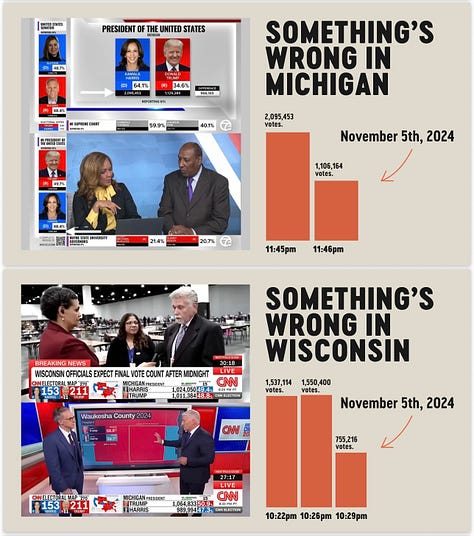
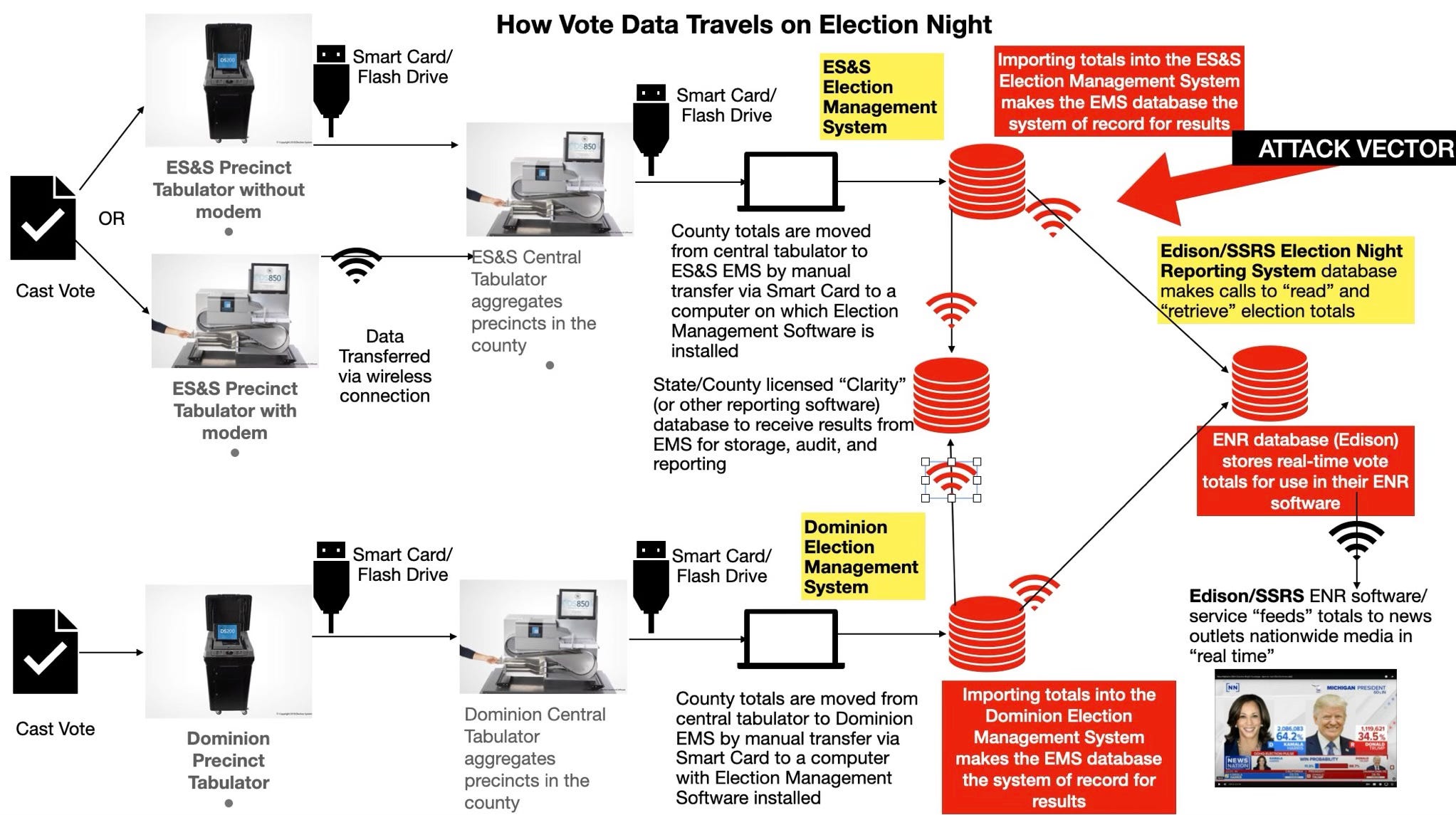
As documented previously in Florida and Michigan, our position is that the ballots themselves were likely tabulated correctly, but that vote totals stored in election-reporting databases were altered after tabulation.

The Attack Vector

Why Georgia’s audit wouldn’t catch it:

Georgia’s post-election audit used Optical Character Recognition (OCR) technology to read the human-readable text on all 5.3 million ballots cast in the 2024 election. The review identified just 87 discrepancies between the original count and the audit, all of which were attributed to human error.

The audit also compared the human-readable text on each ballot to the QR codes generated by Dominion’s ImageCast X ballot-marking devices and scanned on Election Night.

The state concluded:

“There were zero differences found between the tabulation based on the human-readable text and the tabulation based on the QR codes generated by the Dominion ImageCast X ballot marking devices. In every instance, the human-readable text on the paper ballots matched the votes represented in the QR code on that ballot.”

Which sounds reassuring.

But that is not what occurred.

The audit verified that ballots matched the QR codes and that the tabulation system accurately read those ballots. What it did not do was compare audited ballot totals to the final certified election results after those totals moved from the precincts into election-reporting systems.

If vote totals were added, removed, or altered after tabulation through changes made in an election-reporting database, those changes would have no effect on whether the ballots matched the QR codes or whether the scanners correctly interpreted the ballots.

In other words, a ballot-level audit can confirm that ballots were tabulated correctly while still failing to detect changes made later in the system of record.

Our position is that Georgia’s ballots were tabulated correctly, but that vote totals were altered after tabulation through changes made to the system-of-record database.

Unlike a hack at the precinct level, a vote bank operating upstream from tabulation would not appear in traditional audits, making it far more difficult to detect without an investigation into the platforms through which the attack was carried out.

In the Georgia 2024 election, a fake county vote bank was created in a database separate from the system of record. This vote bank was labeled “Hamilton County”—a jurisdiction that does not exist in Georgia. The alternate vote totals were stored there until they were pushed into the system of record.

The “Hamilton County” vote bank contained presidential votes associated with all 265,648 voters who returned a mail ballot before Election Day, along with an additional 51,320 voters who requested a mail ballot in 2024 but never returned one.

In total, the Hamilton County vote bank held votes for 316,968 registered Georgia voters—although it is unlikely that the votes contained in the “bank” actually aligned with voter intent.

What is clear, is that this vote bank was used on Election Night to adjust vote totals in the system of record and likely alter the outcome of Georgia’s presidential election.

Certified Totals

Georgia’s certified presidential results show:

  • Total votes for all candidates: 5,250,905
  • Write-in votes: 858
  • Total counted votes: 5,251,763

The certified margin of victory was 115,100 votes.

We also identified an important discrepancy between certified totals and election reporting data.

If the AP data feed reports 5,250,072 votes for just Trump and Harris through Nov 21, then that only leaves room for 1,691 votes for all remaining candidates and write-ins.

Georgia Early Vote Metrics

The University of Florida Election Lab reported the following figures for Georgia:

  • Total Early Votes: 4,031,303
  • In-Person Early Votes: 3,765,655
  • Mail Ballots Returned: 265,648
  • Mail Ballots Requested: 316,968

Last updated November 5, 2024.

The number 316,968 is central to this investigation.

These numbers become important when we examine the appearance of Hamilton County on Election Night.

Hamilton CO, Georgia: A County That Does Not Exist

At timestamp 55:41 in the DDHQ feed, the “Hamilton County” vote bank contained 316,156 votes on Election Night. That figure does not account for rounding, third-party candidates, or write-in votes.

Hamilton County first appeared in the DDHQ feed at approximately 7:25 p.m. ET during Breaking Points’ election coverage.

At that moment Georgia reported:

  • 316,968 mail ballots requested
  • 265,648 mail ballots returned
  • 51,320 mail ballots requested but not returned
  • 1,219,612 Election Day votes

At approximately 7:25 p.m., Breaking Points displayed Hamilton County, Georgia with:

  • Trump: 178,482 votes
  • Harris: 136,207 votes
  • Oliver: 920 votes
  • Stein: 547 votes

The cumulative vote total displayed for all candidates:

  • 316,156 votes
  • the feed simultaneously showed 5,028,917 estimated votes remaining in Hamilton County for an expected total of 5,345,073 votes.

In the Georgia 2024 election, 316,968 mail-in ballots were requested. The significance of the 316,156 cumulative total is that it sits just 812 votes below Georgia’s statewide total of 316,968 requested mail ballots.

812 more than the “Hamilton County” totals we can see displayed on the screen.

The number 316,968 is central to this analysis.

If we assume that the Hamilton County vote bank was created similar to Florida with a fixed variable in advance of the election, using 316,968 mail-in ballot requests, then 316,968 = 100%

  • Trump: 178,482 / 316,968 = 0.563091542363898 %
  • Harris: 136,207 /316,968 = 0.429718457383711 %
  • Oliver: 920 / 316,968 = 0.00290250119885919 %
  • Stein: 547 / 316,968 = 0.00172572625627824 %

Vote Share % = 0.997438227202746 %

Combined, those allocations account for 99.7438227202746 % of the vote bank.

The remaining 0.2561772797254% equals 812 records.

That figure matches the difference between the statewide requested-mail-ballot total and the vote total displayed inside Hamilton County.

316,968 – 316,156 = 812

100% – 99.7438227202746% = 0.2561772797254%

0.2561772797254% of 316,968 = 812

Meaning this vote bank was used to alter the counted votes stored in the system of record, and likely, to change the outcome of the presidential race.

Allocating Returned and Unreturned Ballots

The evidence indicates the Hamilton County vote bank was built from all requested mail ballots, and included both returned and unreturned ballots.

Georgia reported:

  • 316,968 ballots requested
  • 265,648 ballots returned
  • 51,320 ballots requested but not returned

Within the vote bank around 7:25 pm ET, Trump was allocated 178,482 votes.

If those votes were drawn from the pool of returned ballots, Harris would have only 87,166 returned-ballot votes available:

265,648 – 178,482 = 87,166

Yet Harris appears in the vote bank with 136,207 votes.

That creates a difference of:

136,207 – 87,166 = 49,041

Under this model, those 49,041 votes must come from records associated with voters who requested ballots but never returned them.

Because the vote bank contained 51,320 such records, that would leave:

51,320 – 49,041 = 2,279 unused records.

That figure appears again when we compare requested ballots to the combined Trump-Harris vote total displayed inside Hamilton County:

316,968 – 314,689 = 2,279

The same numbe appears through two independent calculations and we are working on additional findings. Stay tuned.

What Happened After Hamilton County Appeared?

We first observe Hamilton County on the DDHQ feed at approximately 7:25 p.m. ET.

Immediately afterward, Hamilton County vote totals appear to be reflected in statewide election reporting across multiple feeds.

Before Hamilton County appeared, DDHQ showed:

  • Harris: 83,568
  • Trump: 79,059
  • Combined: 162,627

After Hamilton County appeared:

  • Harris: 136,207 (+52,639)
  • Trump: 178,482 (+99,423)
  • Combined: 314,689 (+152,062)

The Associated Press feed shows a similar pattern.

Before deployment, Harris led by 4,509 votes.

After deployment, both candidates gained votes, but Trump took over the lead with a margin of 46,784 votes.

The Edison feed follows a similar trajectory.

Different reporting feeds.

Different reporting organizations.

The same directional movement.

Methodology

The Florida mathematical analysis demonstrated the use of a fixed variable to populate the vote bank—a number the perpetrators could depend on. In Florida, that number was the combination of Republican and Democratic mail-in ballots plus early-voting ballots: 6,371,645.

The “Burke County” vote bank total: 6,371,645.

In Michigan, the fixed variable was the total number of permanent vote-by-mail voters: 1,887,204.

The “Oklahoma County” vote bank total: 1,887,204.

In Georgia, the fixed variable was the number of requested mail-in ballots: 316,968.

The “Hamilton County” vote bank total: 316,968.

To create such a vote bank, a perpetrator would need access to voter data. We know Elon Musk’s 2024 America PAC collected voter information through its million-dollar giveaway campaign, which encouraged voters to submit their information for a chance to win $1 million.

America PAC did not register voters for the election. Instead, it collected voter information. In other words, it functioned as a large-scale voter-information harvesting platform and provided the information necessary to create a fake county vote bank.

This is the point at which we ask readers, legislators, and frankly, the entire country to exercise a little common sense.

We would be having an entirely different conversation if Musk’s America PAC had actually been used to register voters.

But we know it wasn’t.

So ask yourself—and ask your legislators and state attorneys general:

  • Why did Elon Musk create a voter-information harvesting platform that did not register voters?
  • For what purpose did Musk need access to voter data?
  • Why was he so eager for sign ups that he gave away $1 million per day to people who entered their information into the platform?
  • And why create a fake county vote bank if not for the purpose of manipulating vote totals?

This is where cumulative common sense should be sounding every alarm.

Math Aside: What Else Do We Know?

To recap:

  • 2022 — Leonard Leo sells Tripp Lite, an approved vendor for more than 70% of U.S. election equipment, to Eaton Corporation.
  • January 2024 — Musk begins fast-tracking the launch of a new low-Earth-orbit DTC constellation, a project experts said should have taken more than two years to build.
  • February 2024 — Musk files paperwork for America PAC. (His support for Trump therefore has nothing to do with the later assassination attempt.)
  • April 2024 — Musk begins hosting “billionaire brain trust” meetings that include Rupert Murdoch and Jeff Bezos.
  • May 2024 — Peter Thiel funds Polymarket.
  • May 2024 — Eaton Corporation, with access to roughly 70% of U.S. election-equipment infrastructure, announces a “deepening relationship” with Palantir.
  • July 2024 — Musk officially launches America PAC, described by critics as a voter-information harvesting and Trump fundraising operation, using Republican-linked Chain Bridge as its financial institution.
  • Summer 2024 — At multiple rallies, Trump tells supporters that he doesn’t need any votes because he already has all the votes he needs. He also states that “… in four years, we’ll have it fixed so good, you’re not gonna have to vote again.” At yet another event, he says, “I’m being told I have all the votes I need.” (Told by who?)
  • July 22, 2024 — Musk announces completion of the Memphis supercomputer needed for the new DTC constellation in an astonishing 19-day timeline.
  • September 2024 — Eaton partners with Elon Musk and Tesla.
  • October 4, 2024 — Republican-linked Chain Bridge launches its IPO. Reuters notes the considerable risks if Republican electoral fortunes change.
  • October 5, 2024 — According to The New York Times, Musk texts a friend, now known to be Ashley St. Clair:

“I’m feeling more optimistic after tonight. Tomorrow we unleash the anomaly in the matrix.”

An hour later, he adds:

“This isn’t something on the chessboard, so they’ll be quite surprised. ‘Lasers’ from space.”

  • October 7, 2024 — Musk jokes during an interview with Tucker Carlson: “If Trump loses, I’m f*cked. How long do you think my prison sentence is going to be?”
  • October 25, 2024 — Rupert Murdoch’s Wall Street Journal publishes reporting that Musk had communicated with Putin and Xi Jinping for more than two years.
  • October 30, 2024 — The DTC satellites launch, activating the 265-unit constellation less than a week before Election Day.
  • October 30, 2024 — Chain Bridge shares surge to more than three times their average trading volume.
  • October 30, 2024 — Polymarket predicts the exact outcome of the presidential election.
  • November 4, 2024 — Trump states that he and Mike Johnson have “a little secret” that will have a great effect on the House race.
  • November 5, 2024 — Trump wins the election, carrying every swing state just above the threshold for an automatic recount.
  • November 6, 2024 — Trump thanks Elon Musk for his knowledge of “vote-counting computers.”
  • December 2024 — Ashley St. Clair takes her concerns about the election to an operative within the government.
  • January 2025 — Trump returns to office. Musk and DOGE begin dismantling federal agencies and programs while numerous investigations and regulatory actions involving Musk’s companies are paused, dismissed, or otherwise disrupted.
  • Jan 20, 2025 — Trump issues EO that leads to a pause in election security activities.
  • February 5, 2025 — CISA employees are pushed out of their jobs by the DHS via deferred resignation.
  • February 14, 2025 — CISA freezes all election security activities, Elon Musk’s DOGE fires remaining employees.
  • February 2025Trump states that blue states will “totally disappear from the map” during the midterms and promises a “big, big surprise.”
  • March 2025 — Trump issues an executive order that shifts federal election authority away from Congress, the states, and the EAC, placing key responsibilities under the Executive Branch, the DOJ, and DHS.
  • March 2025 — Elon Musk’s team threatens Ashley St. Clair with “criminal charges” if she discloses any personal information about him.
  • April 2025 — Ashley St. Clair takes her concerns about the election to The New York Times.
  • May 12, 2025 — The DOJ begins demanding states’ election-related records and voter lists.
  • May 31, 2025 — Ashley St. Clair’s “lasers from space” story is published in The New York Times, bringing renewed attention to Musk’s statements made shortly before the election.
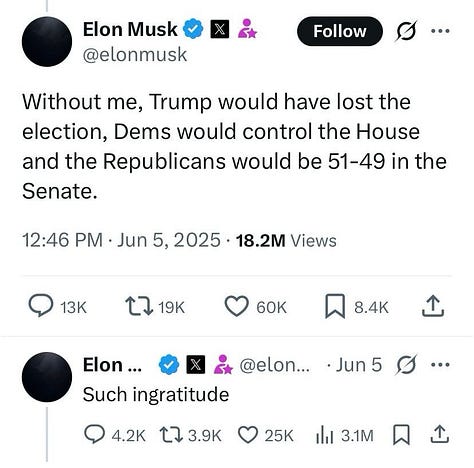
  • June 2025 — Musk publicly states that Trump would have lost the election without him, adding that Democrats would have controlled the House and that Republicans would have held only a 51–49 majority in the Senate.
  • June 2025 — Musk publicly alleges that Trump appears in the Epstein files, exacerbating a public feud between the two men.
  • July 24, 2025 — Todd Blanche meets with Ghislaine Maxwell. In the weeks that follow, Maxwell is transferred to a different federal facility, prompting questions about the purpose of the meeting and the timing of the transfer.
  • July 31, 2025 — former CIA whistleblowers come forward stating that an NSA-authorized audit concluded Kamala Harris won the 2024 election by a substantial margin and that the findings were buried to protect the wealthy elites in the Epstein files.
  • August 18, 2025 — Trump threatens to unlawfully end mail-in voting.
  • September 2025 — Epstein’s “Birthday Book” is released, corroborating aspects of the whistleblowers’ statements and offering the public a rare glimpse into Epstein’s network of wealthy and politically connected associates.
  • Fall 2025 — Congressional efforts to release additional Epstein-related records stall following the assassination of Charlie Kirk. House Speaker Mike Johnson adjourns the House for an extended period, delaying further action.
  • November 2025 — Researchers identify five fake-county vote banks across the swing states and Florida, revealing a pattern that appears across multiple election datasets.
  • December 15, 2025 — DOJ files suit in Fulton County, demanding access to 2020 election records.
  • December 2025 — Epstein files are released, renewing scrutiny of wealthy and politically connected individuals named in the records.
  • February 2026 — Trump’s DOJ illegally raids Fulton County and confiscates ballots from the 2020 election, including records containing sensitive voter data.
  • February 2026 — The Florida fake-county vote bank is mathematically reconstructed and, according to researchers, its role in the election can be demonstrated through publicly available data.
  • March 2026 — Researchers publish similar findings in Michigan, arguing that a second fake-county vote bank influenced reported election totals.
  • March 2026 — Sheriff Chad Bianco illegally raids Riverside County and confiscates ballots from the 2024 election, including records containing sensitive voter data.
  • April 2026 — The Michigan fake-county vote bank is mathematically reconstructed.
  • May 2026 — Ashley St. Clair comes forward publicly, making statements that corroborate election interference and real-time vote monitoring.
  • June 2026 — Whistleblower Vincent Reed comes forward publicly regarding Aleria, a UAE-based company he says he helped introduce to individuals associated with the Trump campaign and Elon Musk.
  • June 2026 — Researchers note that Aleria’s founder publicly promotes the platform’s election success rate of 100%, prompting additional scrutiny of its real time data capabilities and deployment.
  • June 2026 — Musk and Trump publicly reconcile after their brief falling out, as attention increasingly turns toward the 2026 midterm elections.
  • May 2026 — Trump is found to be replicating Vote.gov, Passport.gov, and other government websites containing sensitive voter PII through the National Design Studio, placing those systems under the Executive Branch.
  • May/June 2026Trump’s approval rating falls to 36%, tying Richard Nixon’s historic low, yet his endorsed primary candidates win every single race: 118 for 118.
  • June 2026 — The Georgia fake-county vote bank is identified and reconstructed, becoming the third state in which researchers conclude election-night vote totals were altered after tabulation.

This timeline is only a partial reconstruction of the events surrounding the 2024 election, yet thus far it has not prompted a congressional investigation.

That alone should cause us to ask why.

The “Why”

We have learned more about government corruption, the military-industrial complex, the never-ending war machine, and stolen elections in the last 18 months than we ever wanted to know.

To be clear: Trump’s ties to Russian mobsters predated his 2015 campaign announcement by at least 30 years. Beginning in the 1980s, Trump Tower and several of his other properties became havens for Russian oligarchs laundering money, some of whom were later tried and convicted.

The DOJ could have arrested him at any point during that period, but never did. Instead, institutions remained silent as he announced his candidacy.

And Merrick Garland could have acted swiftly in prosecuting Trump for his crimes—but he didn’t. He slow-walked the prosecution to protect Jared Kushner and by default, his friend Jamie Gorelick.

Meanwhile, the judicial system shifted toward blatant unconstitutionality to pave the way for Trump’s return. From Florida, to Georgia, to the grossly corrupt Supreme Court, it was clear to anyone paying attention in 2024 that the Federalist Society was returning Trump to office no matter what obstacles stood in his way.

They simply removed them.

Donald Trump was—and remains—one of the most dangerous threats to national security in American history, yet in 2015 the intelligence agencies chose to do nothing to stop him. In 2016, they looked the other way as Russia infiltrated our electronic voting apparatus in all 50 states and allowed him to steal the presidency. And in 2024, they looked away as Elon Musk, Russia, and the GOP did the same.

Elections are being electronically rigged to benefit the top 5%, the military-industrial complex, Israeli Zionists, and the wealthy elites on both sides of the political aisle who like to rape children—but prefer not to go to prison for it.

So in protecting Trump, they are also protecting themselves.

What We Can Do About It

We need to spread the word: we are not getting out of this fascist hellscape until investigations begin and the people inside DOGE and the National Design Studio are forced to choose between loyalty to Trump, Thiel, and Musk—or a prison sentence.

The mechanism for change is not complicated.

Lather. Rinse. Repeat.

Until we gain traction.

I’ve personally been in legislators’ offices when the phones were ringing off the hook because constituents were angry. I’ve watched elected officials scramble when enough people showed up demanding answers.

So call.

Email.

Request meetings.

Go to their offices. Bring friends. Organize gatherings at their district offices. Show up consistently and make your voices impossible to ignore.

This is your right as a citizen, and it works.

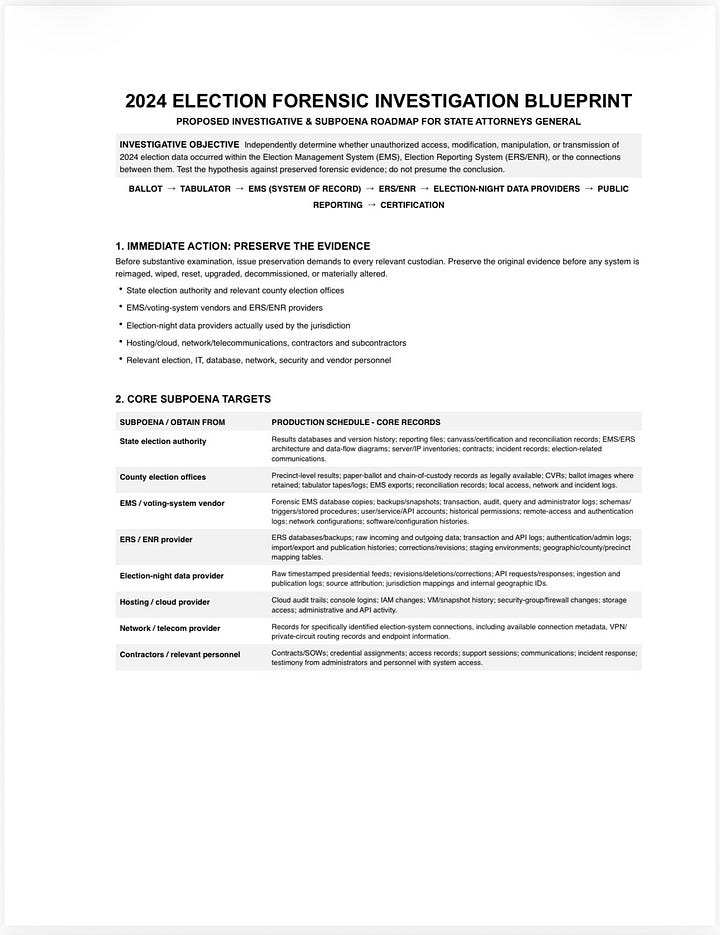
Secretaries of state and state attorneys general should open investigations into the 2024 election, including the roles and activities of Peter Thiel, Elon Musk, Eaton Corporation, DOGE, ES&S, Dominion, Pro V&V, D